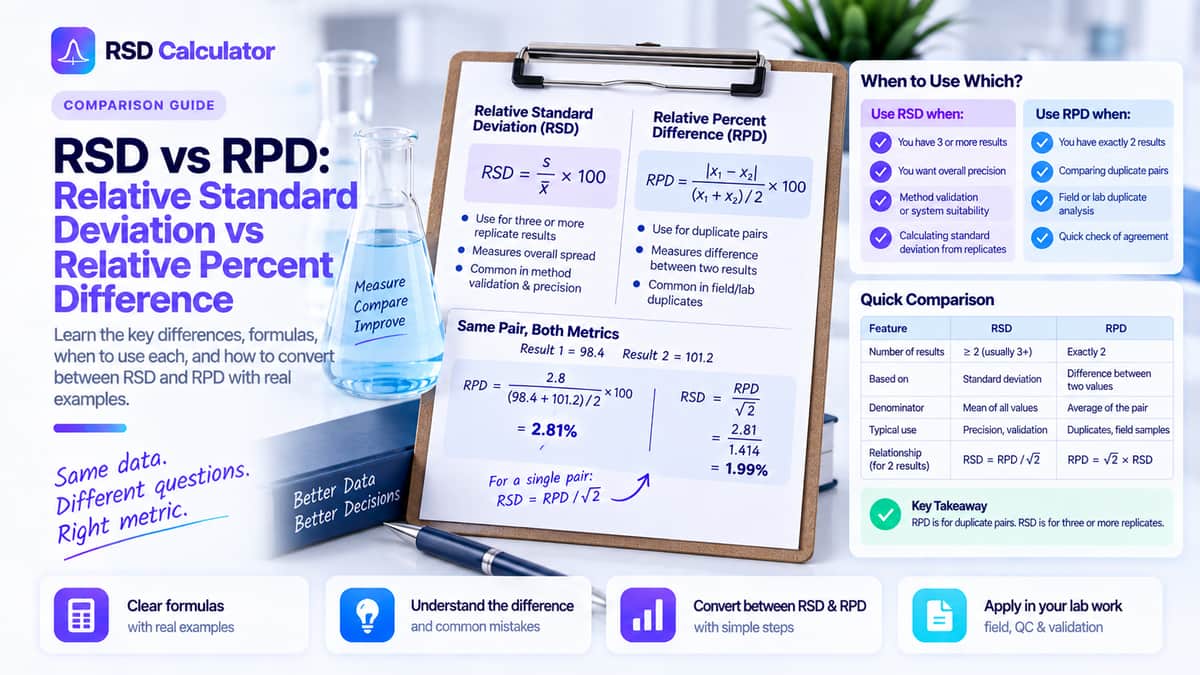
RSD vs RPD: Relative Standard Deviation vs Relative Percent Difference
RSD vs RPD explained: formulas, when to use each, why RPD is for duplicate pairs and RSD for replicate sets, and how to convert between them.
Read More →Articles on statistics, RSD, and how to think about variability.
RSD vs RPD explained: formulas, when to use each, why RPD is for duplicate pairs and RSD for replicate sets, and how to convert between them.
Read More →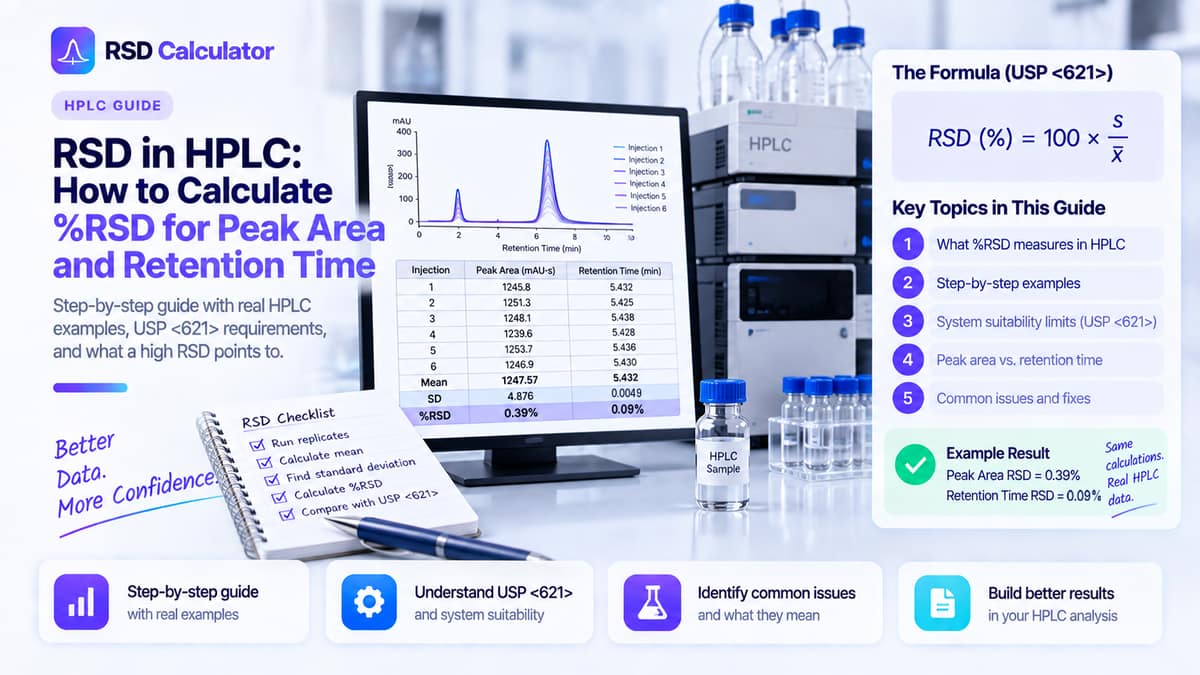
How to calculate %RSD for HPLC peak area and retention time from replicate injections, what USP <621> actually requires, and what a high RSD points to.
Read More →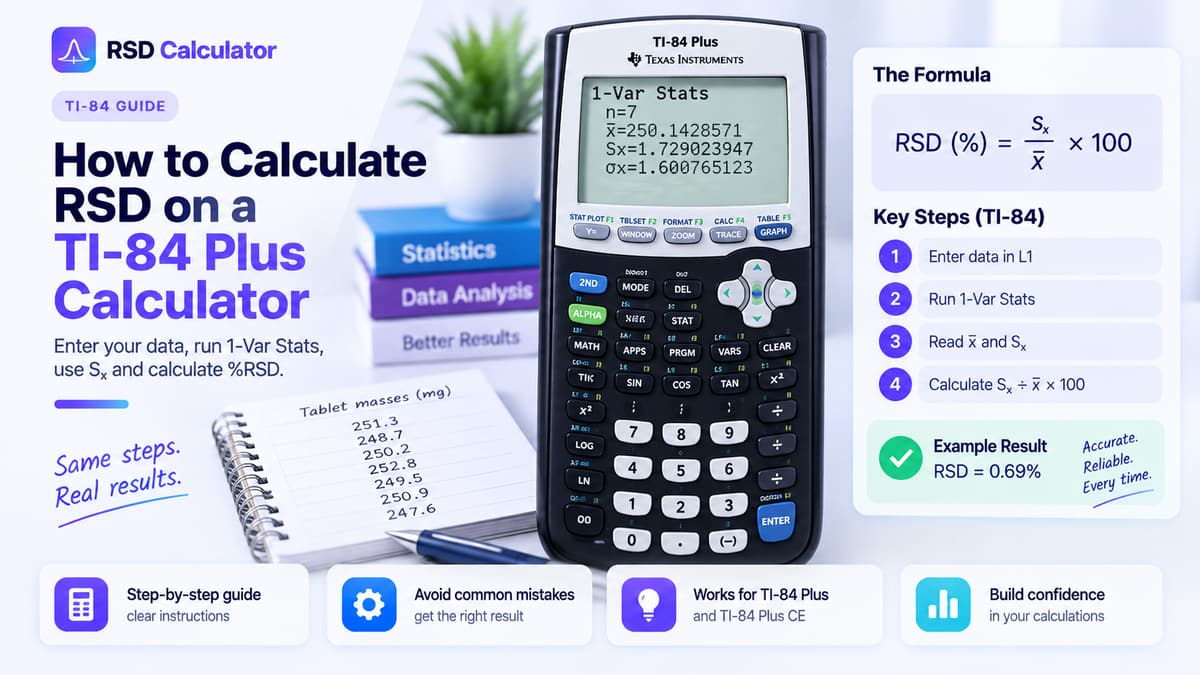
Calculate %RSD on a TI-84 Plus or TI-84 Plus CE: enter data in L1, run 1-Var Stats, choose Sx or σx, and compute Sx ÷ x̄ × 100 without retyping rounded values.
Read More →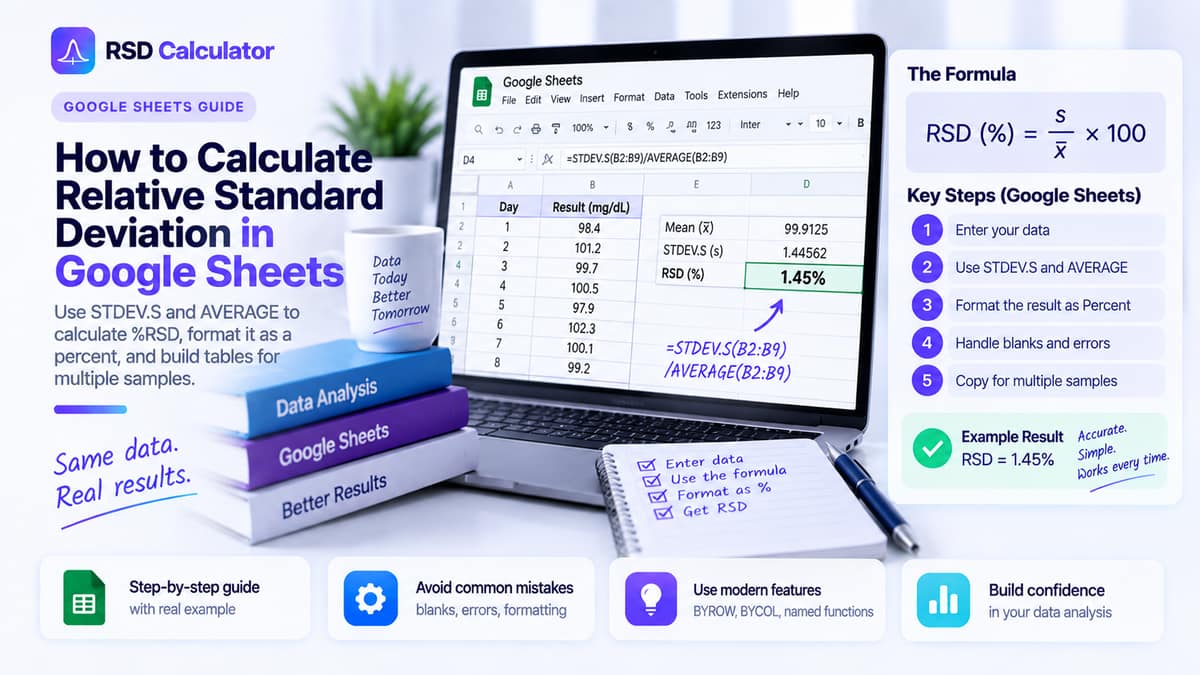
Calculate RSD in Google Sheets with STDEV and AVERAGE, format it as a percent, use open-ended ranges, and get RSD for every row or column with BYROW and BYCOL.
Read More →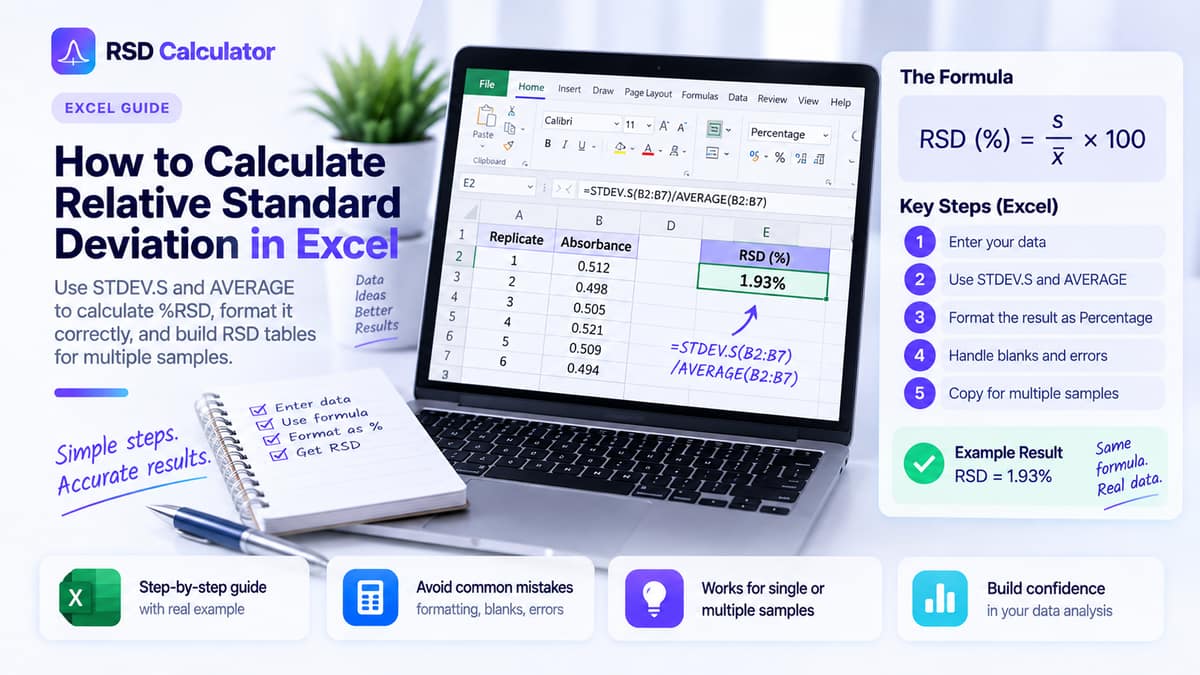
Calculate RSD in Excel with STDEV.S and AVERAGE, format it as a percentage correctly, handle blanks and #DIV/0!, and build an RSD table for many samples.
Read More →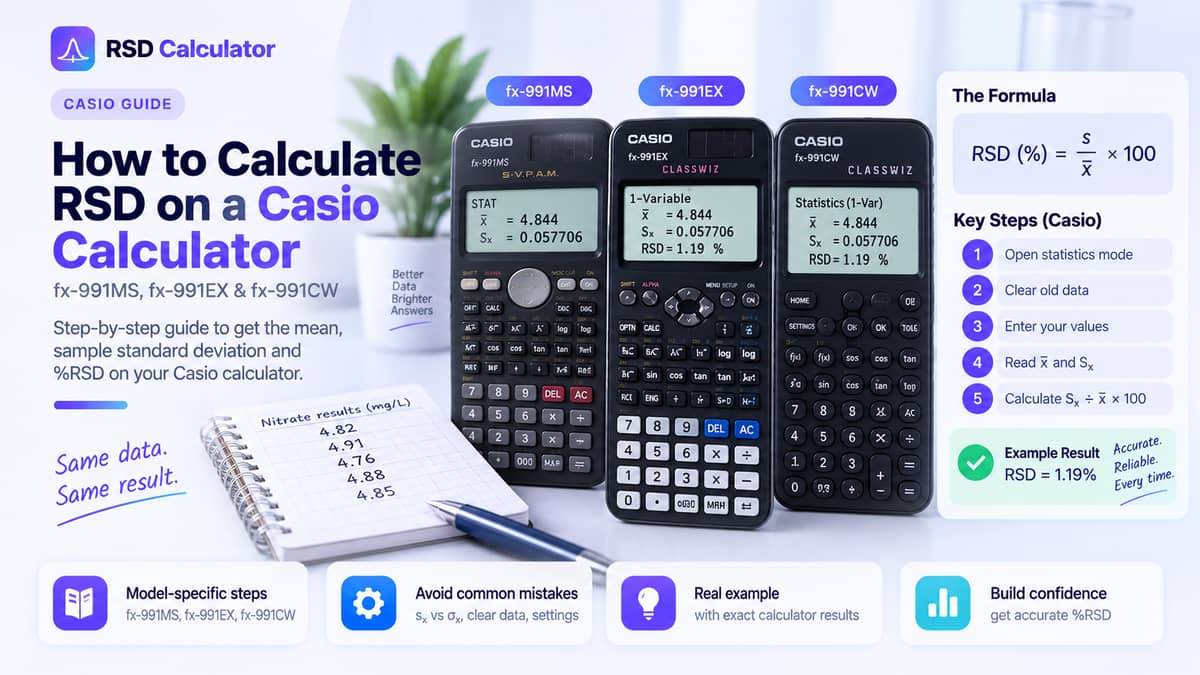
Step-by-step %RSD on the Casio fx-991MS, fx-991EX and fx-991CW: statistics mode, data entry, sx vs σx, and typing sx ÷ x̄ × 100 with the stored values.
Read More →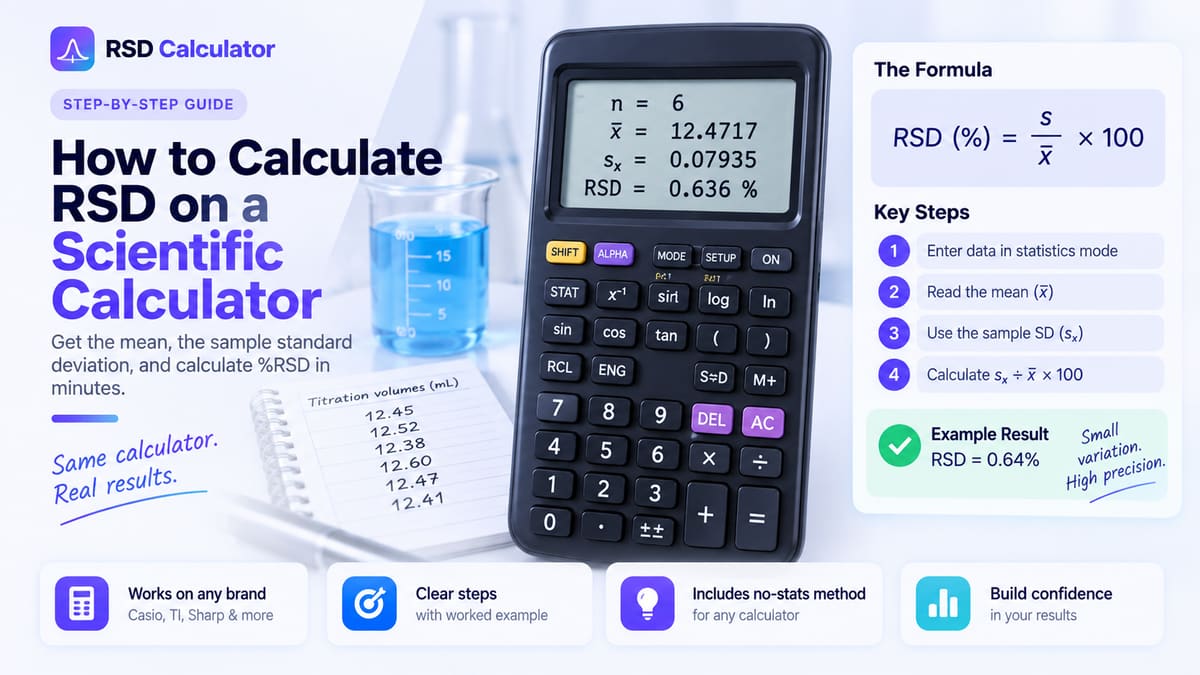
Calculate %RSD on any scientific calculator: use statistics mode for the mean and sample SD, pick sx or σx correctly, then divide. Includes a no-stats method.
Read More →A plain-English introduction to RSD what it measures, why it's expressed as a percentage, and how to interpret the result in real-world contexts.
Read More →The difference between dividing by n and dividing by n − 1 what Bessel's correction actually does, and how to pick the right formula for your data.
Read More →How analysts use relative standard deviation to judge precision, set acceptance criteria, and compare assays with concrete numbers from a calibration example.
Read More →